Notes
All PostsArchive
Android1App Store1C++1Cluster1CSS Specificity1CSS-in-JS1Emotion1Erlang1Input Method1iOS2JavaScript2Loaders1Networking1Node.js1Observables1Prerendering1Qt1React2React Native2RxJS2String Processing1WebEngine1Webpack2Windows2
© 2026 HUANG Cheng
All Posts
Qt and React Hybrid Development
Problem and Exploration A recent project posed an interesting question: how do you render AI chat responses with a typewriter effect inside a Qt app? One…
Feb 18, 2025
Detecting App Store Updates in React Native
Sometimes you ship an exciting new feature and want to prompt users to update right away. NetEase Cloud Music — a React Native app — does exactly this.…
Nov 15, 2024
A Little Pitfall in Erlang String Handling
I stumbled upon echo.opera.com — a service that prints out HTTP request headers — and thought it would be fun to build my own. After implementing echo_rs in…
Sep 26, 2024
Recursion in RxJS
The requirement: after a user selects or photographs an image, send it to an image-recognition API. The API rejects images over a certain size and returns…
Aug 1, 2024
The Mystery Behind RxJS iif
A common pattern in business logic: branch on a precondition to decide which API to call. For order payment, if it's a new order call the create-order…
Jun 22, 2024
React Native Pitfalls and Fixes
Publishing to Android App Stores Rejected for Privacy Violations Some Chinese app stores will reject your app with a message like "SDK reads private user…
Jun 3, 2024
Listing and Switching Input Methods on Windows
Approach 1: Via Keyboard Layout Limitation Extracting the layout ID is non-trivial — the code above uses a simplified low-word extraction. For a thorough…
Apr 20, 2024
Pre-rendering React Apps with Webpack
Background For various reasons — performance, SEO, accessibility — it's desirable for React (or other virtual DOM) apps to serve a static version of the page…
May 7, 2023
Handling CSS-in-JS Style Conflicts
A component library built with was repeatedly getting its styles overridden when integrated into a project that used multiple tech stacks. As you can see in…
Apr 22, 2023
Inside Webpack Loaders and Rules
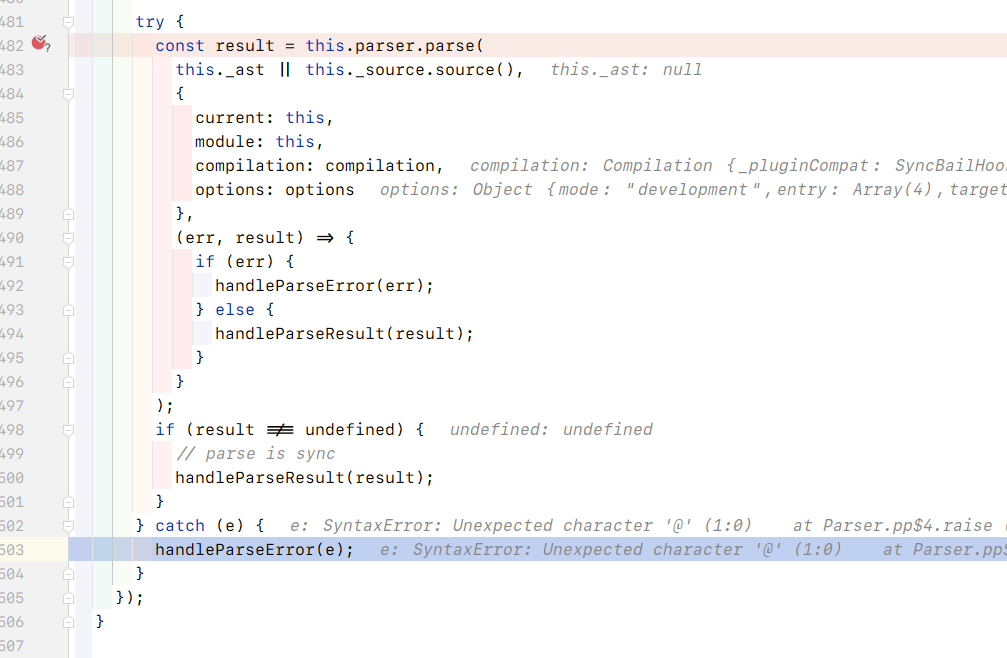
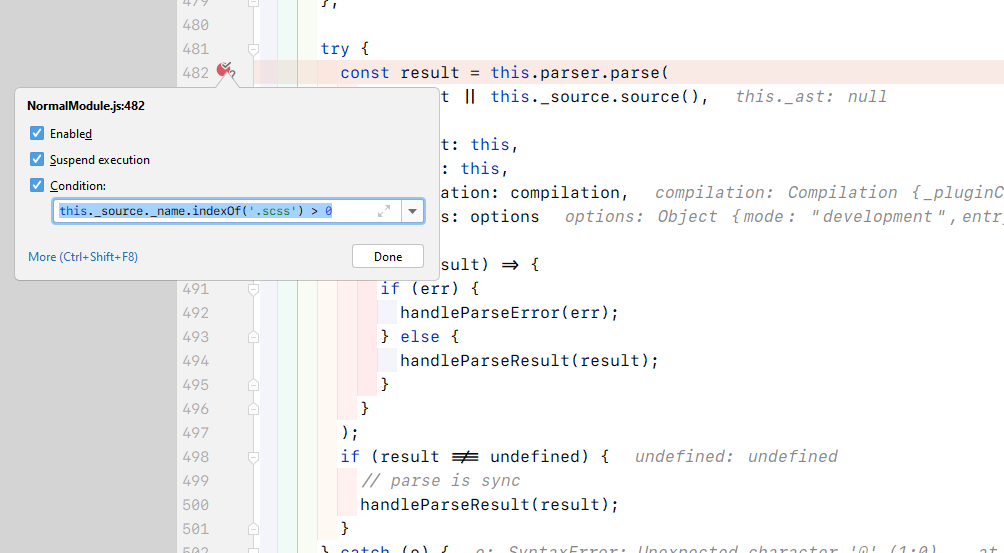
The Problem A webpack-based React project worked fine on macOS and Linux but threw an error on Windows when processing SCSS: Re-installing and confirmed they…
Sep 29, 2022
Why Doesn't Listening on the Same Port in Multiple Node.js Cluster Workers Throw EADDRINUSE?
The Node.js docs show this pattern without any explanation of why it works: Everyone knows that listening on a port twice throws: And indeed, without : So how…
Sep 26, 2022
Handling CSS-in-JS Style Conflicts

Handling CSS-in-JS Style Conflicts

April 22, 2023

A component library built with @emotion/css was repeatedly getting its styles overridden when integrated into a project that used multiple tech stacks.
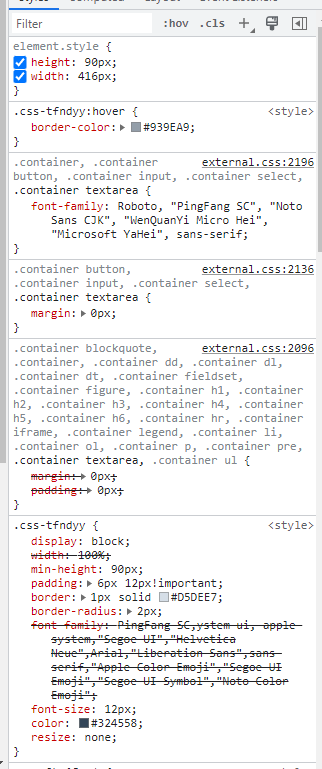
Styles Overridden by Host Styles

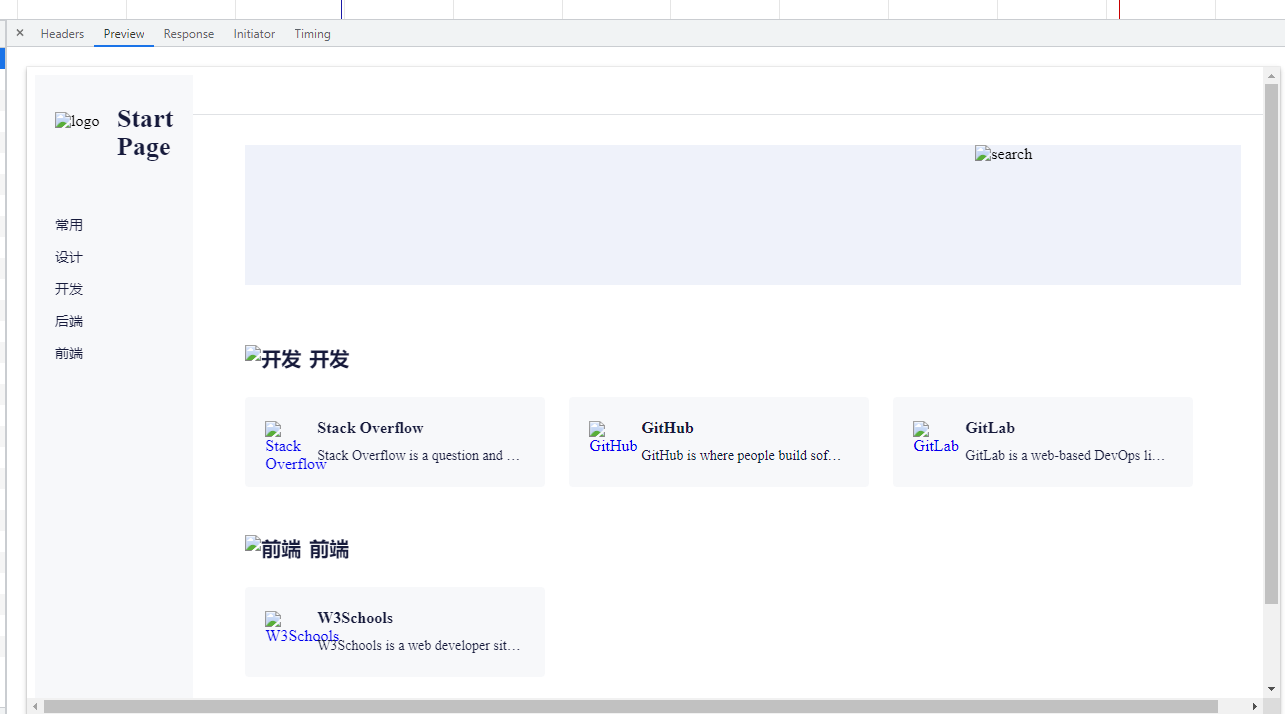
As you can see in the screenshot, the component's styles are being overridden by styles defined in a css file imported by the host project. The root cause: the css-[hash] class selectors generated by CSS-in-JS have relatively low specificity.

According to the Calculating a selector's specificity section of Selectors Level 3:

/* count the number of ID selectors in the selector (= a) */
/* count the number of class selectors, attributes selectors, and pseudo-classes in the selector (= b) */
/* count the number of type selectors and pseudo-elements in the selector (= c) */
/* ignore the universal selector */
 
Examples:
 
*               /* a=0 b=0 c=0 -> specificity =   0 */
LI              /* a=0 b=0 c=1 -> specificity =   1 */
UL LI           /* a=0 b=0 c=2 -> specificity =   2 */
UL OL+LI        /* a=0 b=0 c=3 -> specificity =   3 */
H1 + *[REL=up]  /* a=0 b=1 c=1 -> specificity =  11 */
UL OL LI.red    /* a=0 b=1 c=3 -> specificity =  13 */
LI.red.level    /* a=0 b=2 c=1 -> specificity =  21 */
#x34y           /* a=1 b=0 c=0 -> specificity = 100 */
#s12:not(FOO)   /* a=1 b=0 c=1 -> specificity = 101 */
 
div[data-tag="some-tag-name"] input                      /* a=0 b=1 c=2 -> specificity =   12 */
input[type="text"]                                       /* a=0 b=1 c=1 -> specificity =  11 */
.css-1t321tv                                             /* a=0 b=1 c=0 -> specificity =   10 */

The obvious fix would be adding !important to every conflicting rule, but that's a maintenance nightmare. A more elegant solution follows from a note in the same spec:

Note: Repeated occurrences of the same simple selector are allowed and do increase specificity.

So if @emotion/css could emit a repeated class selector when generating styles, that would boost specificity. It turns out @emotion/css supports this syntax:

<div
  css={{
    '&': {
      width: '100%',
    }
  }}
/>

What if we use && instead of &? Will @emotion/css generate a doubled class name selector?

<div
  css={{
    "&&": {
      width: "100%",
    },
  }}
/>

It does.
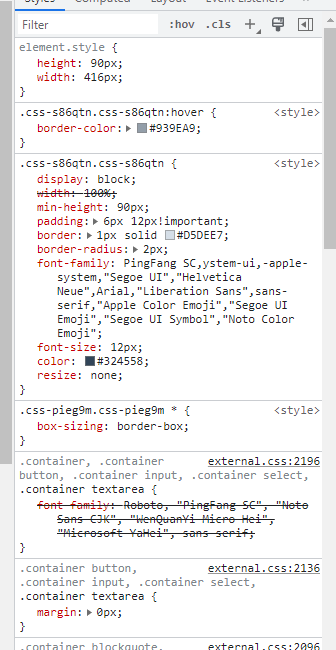
Double Classes

As shown above, @emotion/css generates two identical class names on the element. The resulting selector has specificity a=0 b=2 c=0 → 20, which is enough to beat the vast majority of host styles.

#CSS-in-JS#Emotion#CSS Specificity